
Why Does Opal Diffusing Glass (IOP) Diffuse Light?

This page explains the light-diffusion mechanism behind our Opal Diffusing Glass (IOP), a glass diffuser designed to provide an angular light distribution close to Lambertian.
A key advantage of IOP is its ability to spread incident light uniformly. Compared with conventional frosted glass, it provides greater diffusion, while its spectral transmittance can be adjusted by selecting the appropriate glass thickness.
So, what enables IOP to achieve such uniform light diffusion?
The answer lies in its internal glass structure.
IOP is produced through a process known as phase separation, in which an initially homogeneous glass separates into two compositionally different phases. This finely distributed internal structure creates the light-diffusing properties of IOP.
Glass is generally produced by melting raw materials at high temperatures to form a homogeneous melt, followed by controlled cooling. In conventional homogeneous glass, the internal structure remains largely uniform as the glass solidifies. In IOP, however, phase separation occurs, creating a finely distributed two-phase structure throughout the glass.

▲ Conceptual illustration of phase separation in Opal Diffusing Glass
The two phases have different refractive indices. When light enters the glass, these differences in refractive index cause the light to scatter in many directions throughout the material.
As the light is repeatedly redirected while passing through the glass, the original beam spreads over a broad range of angles rather than remaining concentrated in one direction. The result is diffuse light with an angular distribution close to Lambertian.
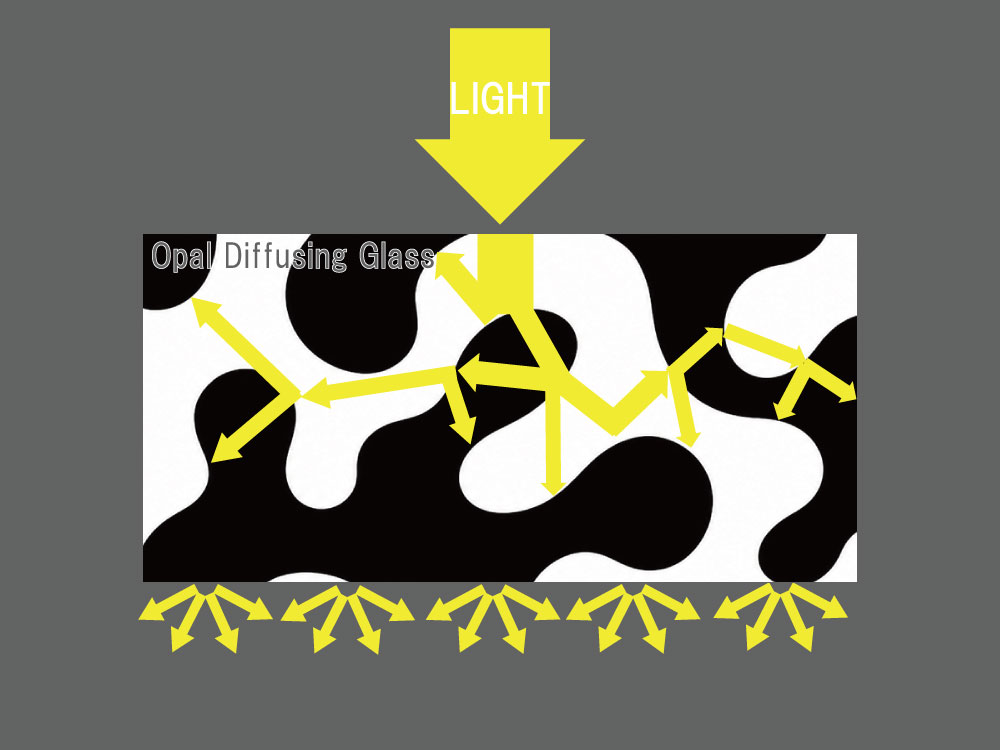
▲ Conceptual illustration of the light-diffusion mechanism
In short, IOP diffuses light because its finely distributed phase-separated structure scatters light throughout the glass. Because this structure is distributed throughout the material, IOP provides stable and uniform diffusion across the glass surface.
These properties make Opal Diffusing Glass (IOP) well suited to applications such as machine-vision LED illumination and observation optics.