
“This Glass May Need to Be Strengthened.” Here’s Why.

At ISUZU GLASS, our development team reviews customer drawings to assess the glass's shape, dimensions, and intended application. Based on this review, we evaluate whether glass strengthening may be necessary.
Depending on the application, we may make recommendations such as:
• “The glass may experience significant temperature differences during operation.”
• “For this application, it may be worth considering a strengthening process.”
But first, what exactly is “strengthened glass?”
• How can glass become stronger while remaining glass?
• What is the difference between strengthened glass and ordinary glass?
• Can you tell whether glass has been strengthened just by looking at it?
In this article, we'll answer these questions and explain how glass strengthening works in straightforward, easy-to-understand terms.
Why Strengthen Glass?
Glass can crack or break when exposed to rapid or uneven temperature changes, particularly when significant temperature differences develop within the glass.
As glass heats up and cools down, it expands and contracts. When different areas of a glass component experience different temperatures, internal forces known as thermal stress can develop. If these stresses become too great, the glass may crack or break.
Glass strengthening introduces a controlled stress distribution into the glass, creating compressive stress near the surface. This helps the glass resist crack formation and breakage.
Strengthening can also improve resistance to thermal stress. However, it does not significantly change the glass material's inherent thermal properties, such as its coefficient of thermal expansion or softening temperature.
When Should You Consider Glass Strengthening?
One situation in which ISUZU GLASS may recommend strengthening is when a glass component is likely to experience significant temperature differences during operation.
For example, an infrared-absorbing filter may become hot while equipment is running and cool down after the equipment is shut off. Depending on the temperature distribution and the design of the component, these changes may increase the risk of thermal stress and breakage.
In such cases, glass strengthening may be worth considering.
How Is Glass Made Stronger?
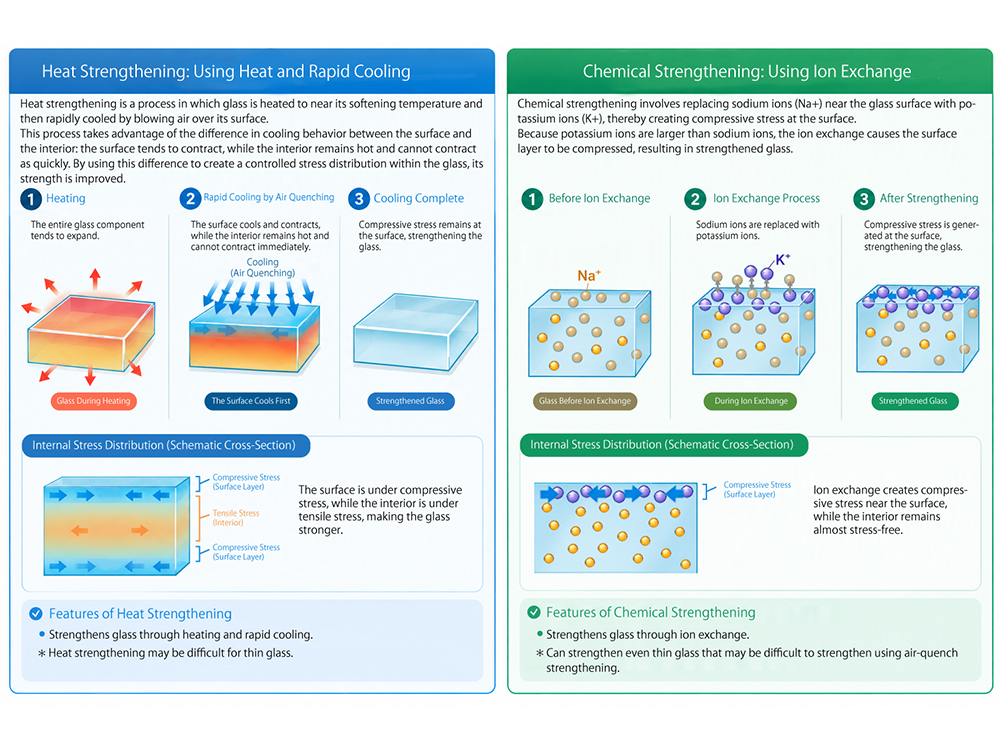
There are two main approaches to glass strengthening: heat strengthening and chemical strengthening.
At ISUZU GLASS, we offer heat strengthening using an air-quench process.
The two methods strengthen glass through different mechanisms.
Heat Strengthening vs. Chemical Strengthening
1. Heat Strengthening: Using Heat and Rapid Cooling
Heat strengthening involves heating glass to an appropriate high temperature, then rapidly cooling its surface by blowing air over it.
During cooling, the surface cools and becomes rigid before the interior. As the hotter interior continues to cool and contract, it creates a controlled stress distribution within the glass.
The surface ends up in a state of compression, while the interior is in tension.
This surface compression makes it more difficult for cracks to form and grow, improving the glass's resistance to breakage.
2. Chemical Strengthening: Using Ion Exchange
Chemical strengthening works differently. In a common process for suitable glass compositions, smaller sodium ions near the glass surface are replaced with larger potassium ions.
This ion exchange creates a compressive stress layer near the surface, making it more difficult for cracks to develop and propagate.
As a result, chemical strengthening can improve the glass's resistance to breakage without requiring the rapid cooling used in thermal strengthening.
At What Stage of Manufacturing Is Glass Strengthened?
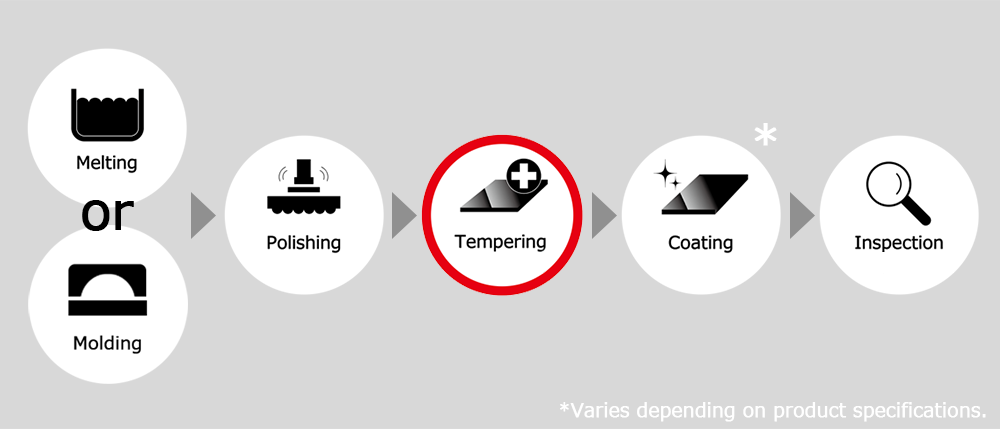
At ISUZU GLASS, the strengthening process is incorporated into the manufacturing workflow at an appropriate stage.
The order of processing is particularly important. Once glass has been strengthened, subsequent machining can affect the compressive stress layer and the overall stress distribution.
For this reason, strengthening is generally performed after major machining operations, such as grinding and polishing, have been completed.
We determine the appropriate process sequence based on each product's shape, material, and technical requirements.
Can You Tell Whether Glass Has Been Strengthened
Just by Looking at It?
You may be wondering whether it is possible to tell if a finished glass component has been strengthened simply by looking at it.
In most cases, heat-strengthened glass cannot be reliably identified through visual inspection alone.
To examine stress-related optical patterns, a specialized instrument called a strain viewer (polariscope) can be used.
By observing glass under polarized light, differences in internal stress can become visible, even when they cannot be seen with the naked eye.
The images below show untreated glass and heat-strengthened glass viewed through a strain viewer.
A strain viewer can help reveal differences in the internal stress state. However, additional measurements may be necessary to quantitatively evaluate the degree of strengthening.
▲ Left: Untreated glass, Right: Heat-strengthened glass
ISUZU GLASS Can Help You Find the Right Solution for Your Application
At ISUZU GLASS, we can evaluate whether glass strengthening is appropriate from a technical perspective if you share details about your operating environment, temperature conditions, glass material, and other application requirements.
If you're unsure whether strengthening is necessary for your glass components, we're happy to discuss your application and help you determine the most suitable approach.

If you have any opinions about the functions or requests,
please contact through below request form.